Just a random thought I've had stuck in my head for awhile now: We become what we listen to. Every piece of music has a philosophy attached to it. If you listen to rap and listen to country music, the philosophy of life and of humanity couldn't be more different. Similarly, traditional Irish music or Gregorian chant creates a different type of spirit than heavy metal. I bet changing the music kids listen to would affect school performance (anyone know of any studies about this?). With that said, it's kindof scary how much power music executives have in shaping our culture.
I think as Catholics, if we want to win the culture wars we need to seize control of the media in a way that we are currently not doing. While it is good that Catholic radio has great apologetics explaining the faith, what we need is to feature music and create a music industry that reflects beauty and stirs the soul. Unfortunately, I don't think that is happening. Through music, we need to make the fullness of truth beautiful so that a secular person may stumble across it on the radio dial and feel their soul uplifted and drawn in to a deeper reality. That should be the vision for Catholic radio.
Monday, June 16, 2008

Saturday, June 14, 2008
State of Marriage
Perhaps one of the scariest things for me in the culture wars is the redefinition of the word "marriage" by the State, and the enforcement of anti-discrimination laws by the Police to punish all those who disagree with this redefinition. Even the conservatives in government seem embarrassed and shamed to fight for an ontologically accurate definition of marriage. Part of it I feel is a lack of understanding of philosophy and the history of ideas. They just don't have the language to confront the misuse of words like "rights", "choice", and "freedom." So tolerance becomes the new intolerance and religious liberty is thrown out the window.
This article is a pretty good commentary on the use of language in this political battle, and the call for Christians to go to work like we did in the days of the old pagan Roman empire.
http://www.catholic.org/politics/story.php?id=28225&page=1
This article is a pretty good commentary on the use of language in this political battle, and the call for Christians to go to work like we did in the days of the old pagan Roman empire.
http://www.catholic.org/politics/story.php?id=28225&page=1
Monday, June 2, 2008
Faith and Art
A moving testimony from Tobias Wolff about beauty and faith:http://www.newyorker.com/reporting/2008/06/09/080609fa_fact_wolff
Thursday, May 1, 2008
Heretics as Theology Professors at a Catholic Universities?
Christopher and I have been arguing about this for the past hour so I thought I'd open it up for discussion on the blog: Should a Catholic university have heretics as teaching faculty in its theology department?
In your response please indicate what you believe the mission of a Catholic university is and how the answer to this question best addresses this mission. My response will come when I have a bit more time to write.
Oh, and Ana Maria, great post about the common denominator discussion.
In your response please indicate what you believe the mission of a Catholic university is and how the answer to this question best addresses this mission. My response will come when I have a bit more time to write.
Oh, and Ana Maria, great post about the common denominator discussion.
Tuesday, April 29, 2008
Common Denominators
It seems to me that the discussion of the lowest common denominator is confusing three distinct realities. The first reality is the deepest desires of our hearts, for truth, beauty, justice, goodness, love, etc. These desires are shared by humanity, though the search for truth, beauty, goodness, justice, and love is often misguided. The second, distinct reality is our instinctual desires. These are also shared by all of humanity, but are our base desires or carnal instincts. Much of popular culture is an appeal to our desire for sex. Lastly, our appeal to a common denominator often manifests itself in an appeal to external circumstances, such as the weather or popular culture.
It is important to distinguish these three ways of relating to other people because it affects how we react to them. Oprah seems to be appealing to the deepest desires of our hearts and proposing that many different ways of getting to God may make one happy/fulfilled. The Christian proposal is that this isn't true, that God Incarnate is the only being or thing that can fulfill those desires. If people recognize the deepest desires of their hearts, then we are able to make this proposal to them.
Normally, however, people do not recognize their desires, or, if they do, they are not able to distinguish between their deepest desires and their instinctual desires. If we are aware of this difference, then we are able to educate ourselves and others to discover the difference between our elementary desires and our instinctual desires. Then we are able to better follow our elementary desires, which, if the Christian proposal is correct, will lead us to Christ.
When we talk with people about common experience, even if that experience is of pop culture, we are able to help educate them (and ourselves) to our desires. If someone likes fashion, we penetrate and ask why. What is it about fashion that's appealing? Well, it is beauty. Overtime, our elementary desires come out.
Educating ourselves and others to the desires of our hearts is the method proposed by Luigi Giussani, the founder of Communion and Liberation. It is, in the (post?)modern world that prizes the individual and the individual's desires, a very accessible method because the starting point is the individual and the individual's desires. This method begins with Giussani's books The Religious Sense and continues with At the Origin of the Christian Claim and Why the Church?
It is important to distinguish these three ways of relating to other people because it affects how we react to them. Oprah seems to be appealing to the deepest desires of our hearts and proposing that many different ways of getting to God may make one happy/fulfilled. The Christian proposal is that this isn't true, that God Incarnate is the only being or thing that can fulfill those desires. If people recognize the deepest desires of their hearts, then we are able to make this proposal to them.
Normally, however, people do not recognize their desires, or, if they do, they are not able to distinguish between their deepest desires and their instinctual desires. If we are aware of this difference, then we are able to educate ourselves and others to discover the difference between our elementary desires and our instinctual desires. Then we are able to better follow our elementary desires, which, if the Christian proposal is correct, will lead us to Christ.
When we talk with people about common experience, even if that experience is of pop culture, we are able to help educate them (and ourselves) to our desires. If someone likes fashion, we penetrate and ask why. What is it about fashion that's appealing? Well, it is beauty. Overtime, our elementary desires come out.
Educating ourselves and others to the desires of our hearts is the method proposed by Luigi Giussani, the founder of Communion and Liberation. It is, in the (post?)modern world that prizes the individual and the individual's desires, a very accessible method because the starting point is the individual and the individual's desires. This method begins with Giussani's books The Religious Sense and continues with At the Origin of the Christian Claim and Why the Church?
Monday, April 28, 2008
LCD, Pluralism, and the Media
I think Christopher and Alberto make excellent point in their posts. First, Christopher is right in that the common denominator of our humanity is really the longing for the truth and for Christ. In this sense, I don't think Oprah's attempt to form a new age religious movement is a deliberate attempt to mislead people. Rather, it's probably a genuine search for a meaning in life that is beyond the superficialness of the Hollywood world. Yet, in that Christoper is referring to the deepest part of our common denominator, I would make distinguish this "highest common denominator" from the "lowest common denominator"referred to in Alberto's post.
Alberto makes a great point in saying that the enjoyment of superficial things is not necessarily a bad thing. If anything, it can bring us together. I agree with this on many fronts. For myself, because I enjoy all the major sports, I find it much easier to talk to guys. If I meet a completely random guy, I can strike up a conversation about a game or a team and we can get along. Similarly, someone told me about the philosophy about talking about the weather. No matter how different you are from someone, no matter how little it appears you have in common, you are both share the weather outside and that's not a bad starting point for conversation.
In that sense, I don't know if lowest common denominator is the right term for what I'm trying to describe, so maybe you all can help me find another term. What I'm referring to is the "it's not polite to talk about politics or religion at the dinner table" kindof attitude. It's a not talking about the things that matter most because it raises tension, people don't budge in their beliefs, and we don't move forward as a society. It's not bad to talk about the weather or superficial things like sports, TomKat, or Shakira. But if that is all you are talking about, if as a society we can't or won't talk about the things that matter most in a meaningful way, what does that mean for our intellectual and political life?
I do think the superficialness has something to do with the sloth of materialism, but I also think it's related to a relativism that's manifested in a politically correct pluralism. If I have a friend who is an atheist, our religious conversations would focus on whether or not there is a God. We couldn't reach the truth about the Eucharist without the foundational piece of agreeing there is a God. Apply that to multiple perspectives on the meaning of life, and given that our media likes to challenge and question the very foundational things that we consider a basic part of our humanity and the natural law, and it's easy to see why it's so hard for popular culture to dive with any depth into truth.
As a result of not diving into truth, the media tries to be "neutral." However, I don't think there is such a thing as an unbiased, neutral media. In merely picking what they choose to be news and what they choose not to report, what they choose to make the headline and what they don't, they are making decisions on what's important by a set of values. I think our contemporary media uses Enlightenment values, underlying in relativism. But that's not being neutral.
Media should report things with an understanding of the good, the true, and the beautiful. Can such a media be a successful mainstream outlet in modern America? What would it like? Is this part of the key to saving Western Civilization?
Alberto makes a great point in saying that the enjoyment of superficial things is not necessarily a bad thing. If anything, it can bring us together. I agree with this on many fronts. For myself, because I enjoy all the major sports, I find it much easier to talk to guys. If I meet a completely random guy, I can strike up a conversation about a game or a team and we can get along. Similarly, someone told me about the philosophy about talking about the weather. No matter how different you are from someone, no matter how little it appears you have in common, you are both share the weather outside and that's not a bad starting point for conversation.
In that sense, I don't know if lowest common denominator is the right term for what I'm trying to describe, so maybe you all can help me find another term. What I'm referring to is the "it's not polite to talk about politics or religion at the dinner table" kindof attitude. It's a not talking about the things that matter most because it raises tension, people don't budge in their beliefs, and we don't move forward as a society. It's not bad to talk about the weather or superficial things like sports, TomKat, or Shakira. But if that is all you are talking about, if as a society we can't or won't talk about the things that matter most in a meaningful way, what does that mean for our intellectual and political life?
I do think the superficialness has something to do with the sloth of materialism, but I also think it's related to a relativism that's manifested in a politically correct pluralism. If I have a friend who is an atheist, our religious conversations would focus on whether or not there is a God. We couldn't reach the truth about the Eucharist without the foundational piece of agreeing there is a God. Apply that to multiple perspectives on the meaning of life, and given that our media likes to challenge and question the very foundational things that we consider a basic part of our humanity and the natural law, and it's easy to see why it's so hard for popular culture to dive with any depth into truth.
As a result of not diving into truth, the media tries to be "neutral." However, I don't think there is such a thing as an unbiased, neutral media. In merely picking what they choose to be news and what they choose not to report, what they choose to make the headline and what they don't, they are making decisions on what's important by a set of values. I think our contemporary media uses Enlightenment values, underlying in relativism. But that's not being neutral.
Media should report things with an understanding of the good, the true, and the beautiful. Can such a media be a successful mainstream outlet in modern America? What would it like? Is this part of the key to saving Western Civilization?
Saturday, April 26, 2008
Percy's Response to the Lowest Common Denominator
There is, it seems to me, a sense in which the LCD can appeal to us in the wrong way. But in some respects, I think these things are ok to indulge in as believers. Just the other day at the dinner table—among my families discussions on politics, religion, and current events—we talked about Shakira (who had just visited Congress), whether TomKat are getting a divorce (they're not...), and yes even Oprah. They're lots of other things that appeal to the LCD in our culture which I'd put among that sports, amusement parks, shopping malls, etc. Each of these has their strengths and their flaws. Some more apparent than others. So I don't think it's pure crass consumerism that's the LCD danger.
The LCD danger comes more from what Walker Percy tries to get at both in The Last Gentleman and The Moviegoer. It's a malaise of daily life whose banality might overwhelm us, but whose discomfort we gladly solace with superficial relationships and petty activities that provide a poor imitation of "the real thing." I worry a lot about false friendships that cover up my own faults and provide only comfort but not healing to my own injuries. Catholicism, I think, forces us to deal with what's the really real about about us (our sin, iniquity, and weakness) and what's really real about God and the world He has created (redemption through His son and a place in His reign through His created world).
In that sense, I can go along enjoying roller-coasters, drinking, and sports with the best of my Pagan friends. But suddenly they mean something really different to me and I'm living life.
Although, sadly, I still do have a guilty weakness for Shakira....
Friday, April 25, 2008
Lowest Common Denominator of What?
Reading Francisco's post, I'm struck by the notion of the lowest common denominator. It seems like the lowest common denominator of humanity is precisely that which applies to all human beings: our incompleteness and our desire. And properly understood, each desire we have is nothing less than a temporal manifestation of our ultimate desire for the infinite, for Christ. The very thing that makes Christ attractive is that He appeals to the lowest common denominator of humanity, our primal needs and desires.
The problem with Oprah's cult, sexy commercials, and nutrigrain is that each takes that desire and directs it towards an incomplete and unfulfilling end. The desire itself that each taps into, the desire for the infinite (manifest in spirituality, in sex, and feeling great) is fundamentally good. The reason each appeals to any kind of common denominator at all is because each appeals to our fundamental desire for the good. But they redirect us to an unfulfilling end, an end that won't fulfill those desires. Those things gives us a incomplete solution to the fundamental problem of our humanity, which is why each of them leaves us, in the end, feeling isolated and incomplete. But the problem is not that they appeal to the lowest common denominator, but its that they appeal to it without giving any real solution or fulfillment.
The problem with Oprah's cult, sexy commercials, and nutrigrain is that each takes that desire and directs it towards an incomplete and unfulfilling end. The desire itself that each taps into, the desire for the infinite (manifest in spirituality, in sex, and feeling great) is fundamentally good. The reason each appeals to any kind of common denominator at all is because each appeals to our fundamental desire for the good. But they redirect us to an unfulfilling end, an end that won't fulfill those desires. Those things gives us a incomplete solution to the fundamental problem of our humanity, which is why each of them leaves us, in the end, feeling isolated and incomplete. But the problem is not that they appeal to the lowest common denominator, but its that they appeal to it without giving any real solution or fulfillment.
Thursday, April 24, 2008
Lowest Common Denominator and Oprah
Switching gears completely, I think much of America's cultural struggles has to do with how we're trying to reconcile our cultural and religious diversity into a singular and unifying popular culture. In an age of consumerism, pop culture attempts to attract the widest audience possible. The way popular music, television, print media, etc. tries to do this is to appeal to the lowest common denominator. Love and sex is an example of this lowest common denominator, and this is the reason television and radio are dominated by these themes. Having parts of humanity that we hold in common with our fellow man is not a bad thing. What is bad is when popular culture reduces the vision of our humanity to nothing more than live-for-the-moment sensual pleasures.
I bring this all up because I think this is what Oprah is trying to do in promoting and offering web seminars on Ethan Tolle's book A New Earth. Through the promotion of this book, Oprah is promoting a religion based on New Age philosophy that teaches there are multiple, equally valid ways to get to God, (and Jesus is only one of these ways as Oprah explains here to this Catholic woman) and God is "a feeling experience and not a believing experience." This is a brilliant use of the lowest common denominator strategy. If you're going to sell something like religion in pluralistic, pop culture America, it doesn't get much lower than "there is no one way". Nevermind that Jesus himself said, "I am the way and the truth and the life. No one comes to the Father except through me" (John 14:6) and nevermind that the claim that "there's no one way" is itself a one way narrow minded view of religion. Somewhat related to this topic is this clip of Oprah getting called out on this point by an audience member in the middle of Oprah's show.
Now, this all relates to our conversation on the best way to influence/change Western civilization. Just as St. Benedict had a method, so does Oprah. Use mass media to have a show that focuses on feel good lowest common denominator subjects. As people can relate their own experience and humanity to the topics of the show (since it is lowest common denominator stuff, it's easy to relate to the subject matter), you earn the people's trust. Then you slowly lead them to a new philosophy and a new religion. As a billionaire, and one of the most powerful and successful people in the very influential mass media, who would dare speak out against Oprah's version of the meaning of life?
Ironically, it's the democratization of the Internet that is leading the charge in calling out Oprah. I first read about this issue a little over a month ago from this article posted by LifeSiteNews.com. Apparently, this wasn't the only site as blogs and YouTube have generated a buzz about this and put it on the radar of the mass media. At the center of it, apparently is this YouTube video that makes the claim that Oprah is starting a cult, which has over 5 million hits. Then Fox News ran this story, asking the question "Is Oprah starting her own cult?" CNN put their finest intellectual and theological experts on this question in this completely unbiased reporting clip. I wonder if CNN's coverage of this topic has anything to do with the fact that Oprah.com is linked to CNN's frontpage.
I view this as a modern day David vs. Goliath. Here you have a billionaire that is the queen of mass media trying to start a religion based on the media values of the lowest common denominator against a handful of unfiltered bloggers and amateur YouTube video producers, who wouldn't have even had a voice but a few years ago. I am real curious how this will all shake out.
I bring this all up because I think this is what Oprah is trying to do in promoting and offering web seminars on Ethan Tolle's book A New Earth. Through the promotion of this book, Oprah is promoting a religion based on New Age philosophy that teaches there are multiple, equally valid ways to get to God, (and Jesus is only one of these ways as Oprah explains here to this Catholic woman) and God is "a feeling experience and not a believing experience." This is a brilliant use of the lowest common denominator strategy. If you're going to sell something like religion in pluralistic, pop culture America, it doesn't get much lower than "there is no one way". Nevermind that Jesus himself said, "I am the way and the truth and the life. No one comes to the Father except through me" (John 14:6) and nevermind that the claim that "there's no one way" is itself a one way narrow minded view of religion. Somewhat related to this topic is this clip of Oprah getting called out on this point by an audience member in the middle of Oprah's show.
Now, this all relates to our conversation on the best way to influence/change Western civilization. Just as St. Benedict had a method, so does Oprah. Use mass media to have a show that focuses on feel good lowest common denominator subjects. As people can relate their own experience and humanity to the topics of the show (since it is lowest common denominator stuff, it's easy to relate to the subject matter), you earn the people's trust. Then you slowly lead them to a new philosophy and a new religion. As a billionaire, and one of the most powerful and successful people in the very influential mass media, who would dare speak out against Oprah's version of the meaning of life?
Ironically, it's the democratization of the Internet that is leading the charge in calling out Oprah. I first read about this issue a little over a month ago from this article posted by LifeSiteNews.com. Apparently, this wasn't the only site as blogs and YouTube have generated a buzz about this and put it on the radar of the mass media. At the center of it, apparently is this YouTube video that makes the claim that Oprah is starting a cult, which has over 5 million hits. Then Fox News ran this story, asking the question "Is Oprah starting her own cult?" CNN put their finest intellectual and theological experts on this question in this completely unbiased reporting clip. I wonder if CNN's coverage of this topic has anything to do with the fact that Oprah.com is linked to CNN's frontpage.
I view this as a modern day David vs. Goliath. Here you have a billionaire that is the queen of mass media trying to start a religion based on the media values of the lowest common denominator against a handful of unfiltered bloggers and amateur YouTube video producers, who wouldn't have even had a voice but a few years ago. I am real curious how this will all shake out.
Monday, April 21, 2008
More about "The Meeting"
As a follow-up to Ky's post about the Holy Father's meeting with some victims of the clerical sexual abuse crisis in the Church, I think anyone who thinks there was an ulterior motive is dead wrong.
Pope Benedict XVI, in his pre-papal days as Joseph Cardinal Ratzinger, was the curial official who read every case file that Boston, or any other diocese, had to hang their heads over. He has read every person's account. Felt, in a way, the pain and hurt that each of these youngest members of Christ's faithful suffered at the hands of who were supposed to be Christ. While the gears of the Church move quite slowly, I think this Pope had to visit with these people, not because he is the leader of the Church whose ministers harmed them, but as a priest himself, as a bishop himself, he had to apologize directly and in-person to at least a few of those harmed by his brother priests and bishops.
As for why this was on the public schedule, this was not a public, or semi-public event. This meeting was almost confessional in nature; this was not to publicly acknowledge past faults of the Church (or members of it) but for a pastor to talk to individual members of his flock. If it was a public event, pre-scripted as many of these Vatican events are, it would be exactly not what the Pope wanted to do. This was a time for him to listen, for those hurt to tell him whatever they wanted. As one of the gentlemen said to CNN later that night, they were never told that they could not say anything. Of the three interviewed, two seemed at some level of peace, but the third still seemed quite angry. That is what Pope Benedict wanted; he wanted to hear the actual voices, as they are, of these faceless, haunting case files he read for years before rising to the Chair of Peter.
What will change in the American Church out of this? I don't know. This crisis is something that virtually no one saw coming or had any idea to expect it. There's no frame of reference to compare this situation. Time will tell.
Pope Benedict XVI, in his pre-papal days as Joseph Cardinal Ratzinger, was the curial official who read every case file that Boston, or any other diocese, had to hang their heads over. He has read every person's account. Felt, in a way, the pain and hurt that each of these youngest members of Christ's faithful suffered at the hands of who were supposed to be Christ. While the gears of the Church move quite slowly, I think this Pope had to visit with these people, not because he is the leader of the Church whose ministers harmed them, but as a priest himself, as a bishop himself, he had to apologize directly and in-person to at least a few of those harmed by his brother priests and bishops.
As for why this was on the public schedule, this was not a public, or semi-public event. This meeting was almost confessional in nature; this was not to publicly acknowledge past faults of the Church (or members of it) but for a pastor to talk to individual members of his flock. If it was a public event, pre-scripted as many of these Vatican events are, it would be exactly not what the Pope wanted to do. This was a time for him to listen, for those hurt to tell him whatever they wanted. As one of the gentlemen said to CNN later that night, they were never told that they could not say anything. Of the three interviewed, two seemed at some level of peace, but the third still seemed quite angry. That is what Pope Benedict wanted; he wanted to hear the actual voices, as they are, of these faceless, haunting case files he read for years before rising to the Chair of Peter.
What will change in the American Church out of this? I don't know. This crisis is something that virtually no one saw coming or had any idea to expect it. There's no frame of reference to compare this situation. Time will tell.
Back to Beauty
Art is created out of the Lack. It comes from the yearning in our hearts for something more. This is significant in terms of our discussion for two reasons. First, most, if not all, prayer also comes from the lack. Thus, there is an intrinsic link between art and prayer. Second, for most artists, there is the lack but no true answer (sometimes the answer is to suppress the question, which is no answer at all). We, however, have an answer; this answer does not take away the lack, but directs it towards something, someone. In fact, this intensifies the lack. Once we identify what our hearts yearn for, our hearts ache that much more. In this yearning for something more (for the Infinite), we are utterly human and utterly dependant. It is in our humanity that we, as Christians, appeal to others. It is when it is clear that we have the same desires as everyone else that the Christian life seems both possible and attractive. Our desires are most evident in our art.
Sunday, April 20, 2008


BXVI in NYC: Pope Benedict XVI arrives

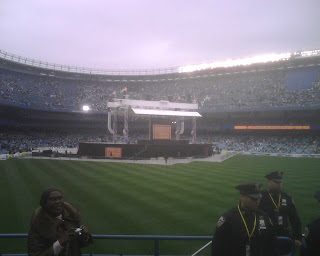
This is an image of the Holy Father's Popemobile arriving on the warning track of Yankee stadium.
BXVI in NYC: Fake Birds

BXVI in NYC: Harry Connick, Jr

BXVI in NYC: Jose Feliciano?

BXVI in NYC: I stand corrected.

BXVI in NYC: Empty Seats?

BXVI in NYC: I can see the back...

Friday, April 18, 2008
The Meeting
By far the most moving moment for me from Benedict's trip to our country has been his surprise visit with sexual abuse victims. The responses in the press have been various, especially from other abuse victims. Some have called it a mere publicity stunt (in one CNN story, someone suggested it was a ploy to get more money for the Church), others lament that it is a distraction from real action to redress just grievances, and some have been moved to tears. John Allen perhaps described it best when he explained that, when an institution has an unbroken 2000 year history, it is rare that we can use the term "unprecedented" to describe an event. But this encounter was truly an unprecedented event. The closest modern parallel I can think of is when Pope John Paul II met with his would-be assassin, Mehmet Ali Agca, in his prison cell. Of course the circumstances were very different, but each meeting was a profound encounter seeking reconciliation, and in each case a pope had to let go of pride and power to offer a healing presence in a ruptured relationship.
Some have asked how the six victims who met the pope were chosen? Were they handpicked because officials knew they would not cause controversy or challenge the pope to act? And why was the meeting private, when a public forum could have brought together many more victims?
I think these are very reasonable questions for people to ask, especially for those who have been terribly injured by the Church. But I think the venue Benedict chose was very fitting for his mission. Unlike at John Paul's meeting with Agca, here there was no press, no photo-ops. Rather, there was an intimate and free encounter in which Benedict first and foremost exercised his role as spiritual father. Those victims who were present and whom I saw interviewed were most impressed by his fatherly presence, calling him a grandfather who, as he listened, they knew understood and cared.
Those who met the pope had met before with other bishops, and they have learned to judge whether someone with authority cares about them and takes them seriously. I'm sure some bishops they have met have not been convinced of their stories, or have taken a coldly doctrinal or legalistic perspective. Benedict's second purpose, I believe, was to set an example to American bishops, who deal with this crisis on a daily basis. A leader is meant to listen and to be a father more than an administrator.
Benedict also set an example for all of us. Imagining the pope hearing such horrible stories that must shake even his faith reminds me of times I have spoken with people, whether young or old, who have been scarred. I think especially of my time as a volunteer hospice chaplain. These encounters often produce anger and frustration in the one who listens, which facilitates solidarity with one who suffers. The pope came to America not only to speak with us, but to learn from us and experience the pain our nation's Church has been through. The encounter the pope had with abuse victims is transformative not only for victims, but also for the pope. How he will be impacted and impelled to new action remains to be seen, but his visit was an important beginning and established, in imitation of Christ, a strong solidarity with and presence to victims. Action and reform ("doing") is always second to presence ("being").
I take the pope's initiative as a call for each of us to openness and dialogue, even the most difficult conversations. We must be ready to experience someone else's perspective, to listen attentively, and to be changed by what we hear. Thus this private moment of his visit is an embodiment of his commitment to dialogue, peace, and pluralism, which he has touched on throughout his talks and which resonate so well with our American heritage.
Some have asked how the six victims who met the pope were chosen? Were they handpicked because officials knew they would not cause controversy or challenge the pope to act? And why was the meeting private, when a public forum could have brought together many more victims?
I think these are very reasonable questions for people to ask, especially for those who have been terribly injured by the Church. But I think the venue Benedict chose was very fitting for his mission. Unlike at John Paul's meeting with Agca, here there was no press, no photo-ops. Rather, there was an intimate and free encounter in which Benedict first and foremost exercised his role as spiritual father. Those victims who were present and whom I saw interviewed were most impressed by his fatherly presence, calling him a grandfather who, as he listened, they knew understood and cared.
Those who met the pope had met before with other bishops, and they have learned to judge whether someone with authority cares about them and takes them seriously. I'm sure some bishops they have met have not been convinced of their stories, or have taken a coldly doctrinal or legalistic perspective. Benedict's second purpose, I believe, was to set an example to American bishops, who deal with this crisis on a daily basis. A leader is meant to listen and to be a father more than an administrator.
Benedict also set an example for all of us. Imagining the pope hearing such horrible stories that must shake even his faith reminds me of times I have spoken with people, whether young or old, who have been scarred. I think especially of my time as a volunteer hospice chaplain. These encounters often produce anger and frustration in the one who listens, which facilitates solidarity with one who suffers. The pope came to America not only to speak with us, but to learn from us and experience the pain our nation's Church has been through. The encounter the pope had with abuse victims is transformative not only for victims, but also for the pope. How he will be impacted and impelled to new action remains to be seen, but his visit was an important beginning and established, in imitation of Christ, a strong solidarity with and presence to victims. Action and reform ("doing") is always second to presence ("being").
I take the pope's initiative as a call for each of us to openness and dialogue, even the most difficult conversations. We must be ready to experience someone else's perspective, to listen attentively, and to be changed by what we hear. Thus this private moment of his visit is an embodiment of his commitment to dialogue, peace, and pluralism, which he has touched on throughout his talks and which resonate so well with our American heritage.
BXVI in NYC: Helicopters Overhead
I'm a dork with anything transpotation related, so one of my big plans for this weekend included a stop at the NYC Transit Museum. I found myself in downtown Brooklyn with time to spare before it opened and since the Brooklyn Bridge was not far, I took a walk to it.
While on the approach ramp, I saw a low-flying NYPD helicopter. This IS New York, so I thought nothing about it.
Moments later, I saw three very official-looking helicopters heading from the Queens/JFK-area that reminded me of what Marine One looked like from The West Wing and all were heading toward where the UN is located.
NYPD helicopters were circling the site where I lost sight of the desending helicopters.
Thinking this all was a bit odd, even for New York, I checked my watch-10:00ish-and called my Pope-obsessed friend Hung. Sure enough, the Pope's schedule had him in route from JFK to the UN via helicopter about that time.
If I'm lucky, he looked down upon the Brooklyn Bridge at that moment and blessed the people on it.
This isn't an academic post, but it is about me literally Waiting for Benedict.
(Note: I'm writing this from my BlackBerry while on a train so I'll add links and the category tonight when I settle in.)
Subscribe to:
Posts (Atom)